
CHICAGO – January 16, 2026 – The HIMSS Electronic Health Record (EHR) Association announced today the results of its annual leadership elections for terms that began Jan. 1, 2026. Leigh Burchell, Vice President of Policy and Government Affairs at Altera Digital Health, will continue as Chair, and Stephanie Jamison, Senior Director of Regulatory and Government Affairs at Greenway Health, continues as Vice Chair.
(more…)All posts in category EHRA News
Electronic Health Record Association Announces its 2026 Leadership Team and Priorities
Posted by EHR Association on January 16, 2026
https://ehrablog.org/2026/01/16/electronic-health-record-association-announces-its-2026-leadership-team-and-priorities/
EHR Association Statement on the White House “Make Health Tech Great Again” Event and Vendor Pledge
The EHR Association shares the following statement regarding the White House’s “Make Health Tech Great Again” event hosted by CMS and announcing a collaborative effort to “begin laying the foundation for a next-generation digital health ecosystem that will improve patient outcomes, reduce provider burden, and drive value.”
The EHR Association welcomes the Administration’s innovative thinking on how to accelerate health data interoperability and information sharing and commends the developer community’s proactive commitment to this voluntary pledge. By expanding access pathways—from patient-facing applications to provider EHRs to payer claims management systems—and encouraging adoption of advanced AI and digital tools, the ‘Make Health Tech Great Again” initiative promises to accelerate progress toward a more connected and transparent healthcare ecosystem. We look forward to working alongside CMS, ASTP/ONC, and other stakeholders to learn more about implementing this important initiative.
– Leigh Burchell of Altera Digital Health, Chair of the EHR Association
Posted by EHR Association on July 30, 2025
https://ehrablog.org/2025/07/30/ehr-association-statement-on-the-white-house-make-health-tech-great-again-event-and-vendor-pledge/
Dr. Thomas Keane to Lead ASTP/ONC
Dr. Thomas Keane has been named Assistant Secretary for Technology Policy (ASTP) and National Coordinator for Health Information Technology (ONC). An engineer and physician, Dr. Keane previously served in ASTP and also as a Senior Advisor to the Deputy Secretary of HHS.
“The EHR Association congratulates Dr. Thomas Keane on his appointment as Assistant Secretary for Technology Policy at HHS and National Coordinator for Health IT. Dr. Keane brings important expertise in health policy to the role,” says Leigh Burchell (Altera Digital Health), Chair of the EHR Association Executive Committee. “We’re pleased that his selection reflects HHS’ commitment to putting leadership in place that both recognizes the criticality of the ‘coordinator’ responsibilities and understands from prior experience the many complex use cases related to health data interoperability that the agency is tasked with supporting. We look forward to collaborating with Dr. Keane and ASTP to further the digitization of healthcare and explore regulatory refinements.”
Among other duties, Keane was an administrator of the COVID-19 Provider Relief Fund and led the development of the AHRQ National Nursing Home COVID Action Network. Dr. Keane worked as a finite element software developer and enterprise software engineer before training as an interventional radiologist.
Posted by EHR Association on June 3, 2025
https://ehrablog.org/2025/06/03/dr-thomas-keane-to-lead-astp-onc/
EHR Association’s Statement on HHS Strategic Plan for AI In Healthcare
By the EHR Association AI Task Force
On January 10, 2025, the Assistant Secretary of Technology Policy (ASTP) released the U.S. Department of Health and Human Services (HHS) Strategic Plan for the Use of Artificial Intelligence in Health, Human Services, and Public Health.
In the press release announcing its release, HHS described the Strategic Plan as establishing both the strategic framework and operational roadmap for responsibly leveraging emerging technologies to enhance HHS’s core mission while maintaining its commitment to safety, effectiveness, equity, and access. It also outlines the ways HHS will deliver on its goal of being a global leader in innovating and adopting responsible AI that achieves unparalleled advances in the health and well-being of all Americans.
We need to ensure that Americans are safeguarded from risks. Deployment and adoption of AI should benefit the American people, and we must hold stakeholders across the ecosystem accountable to achieve this goal.
“At HHS, we are optimistic about the transformational potential of AI,” said Deputy Secretary Andrea Palm. “These technologies hold unparalleled ability to drive innovation through accelerating scientific breakthroughs, improving medical product safety and effectiveness, improving health outcomes through care delivery, increasing access to human services, and optimizing public health. However, our optimism is tempered with a deep sense of responsibility. We need to ensure that Americans are safeguarded from risks. Deployment and adoption of AI should benefit the American people, and we must hold stakeholders across the ecosystem accountable to achieve this goal.”
Key Plan Points
The Strategic Plan outlines how HHS will mobilize an approach to improve the quality, safety, efficiency, accessibility, equitability, and outcomes in health and human services through the innovative, safe, and responsible use of AI by focusing on four key goals:
- Catalyze health AI innovation and adoption to unlock new ways to use AI to improve people’s lives;
- Promote trustworthy AI development and ethical and responsible use to avoid potential harm;
- Democratize AI technologies and resources to promote equitable access for all; and
- Cultivate AI-empowered workforces and organizational cultures to allow staff to make the best use of AI.
HHS says it will adopt a dynamic approach to AI to stay ahead of its rapid evolution while addressing emerging challenges that include Plan updates, continuous risk assessment, stakeholder engagement, and the implementation of robust safeguards that ensure ethical and equitable AI use.
The EHR Association Stance
The EHR Association AI Task Force shares the following thoughts on areas of the Strategic Plan that are of specific interest to the Association’s member companies and the providers who utilize their EHR and other health IT.
We are pleased to see plans to leverage USCDI, USCDI+, HL7, FHIR, and other data standards, along with a focus on TEFCA as a potential transport for information that may be utilized in AI workflows for training or insights. Leveraging the standardized data that already exists in many EHRs will accelerate development of solutions speaking a ‘common language’, as well as the opportunity to benefit from novel AI technologies in the future.
“We are pleased to see plans to leverage USCDI, USCDI+, HL7, FHIR, and other data standards, along with a focus on TEFCA as a potential transport for information that may be utilized in AI workflows for training or insights. Leveraging the standardized data that already exists in many EHRs will accelerate development of solutions speaking a ‘common language’, as well as the opportunity to benefit from novel AI technologies in the future. We are also encouraged to see the ‘human in the loop’ concept throughout the Strategic Plan as a strategy to mitigate risk, particularly at this state of AI maturity,” says Tina Joros (Veradigm), Chair, EHR Association AI Task Force.
When it comes to the expanded scope of HHS responsibilities to appropriately guide safe AI development as outlined in the Plan, Joros notes that “HHS acknowledges that healthcare stakeholders will increasingly use AI technologies and tools that fall outside the scope of FDA regulation or ASTP/ONC authority, including the HTI-1 regulation.”
She adds, “We support conversations about where additional authority may be necessary for HHS to offer meaningful incentives to create uniform standards across the entirety of the healthcare AI ecosystem and not just Certified Health IT. To the extent these incentives also extend to providers using Certified Health IT, they have the potential to spur adoption of AI and build a trusted, transparent system that will help mitigate the risk and cost of adopting new technologies.”
The recognition of the opportunity that exists through artificial intelligence in administrative workflows is a great callout. Innovation in this space can safely improve burnout, as well as the overall cost of healthcare delivery, and thus should be prioritized by policymakers and software developers.
The Association also commends HHS for recognizing the clinical risk inherent in the use of AI in healthcare. AI Task Force Vice Chair Stephen Speicher, MD (Flatiron Health), states: “It is important to take a risk-based approach to developing and deploying AI directly into the healthcare ecosystem. In the AI Strategic Plan, HHS appropriately recognizes the risks that can stem from using AI in high-risk clinical workflows, including diagnosis and treatment, as well as apprehensions about the topic felt by some providers and patients. The recognition of the opportunity that exists through artificial intelligence in administrative workflows is a great callout. Innovation in this space can safely improve burnout, as well as the overall cost of healthcare delivery, and thus should be prioritized by policymakers and software developers.”
Dr. Speicher also acknowledges the potential for AI to widen the technological divide that exists in the U.S. healthcare system and the importance of prioritizing equitable access to AI innovation across the ecosystem.
“A technological divide exists in healthcare in this country, with large high-volume centers in major cities frequently outpacing smaller centers caring for underserved communities,” he says. “We must ensure the deployment of AI technology in healthcare is accessible to small private practices as well as large academic medical centers and health systems to ensure that health equity improves over time in all care settings. Failing to prioritize this, as HHS calls out, risks a further divide in the quality of care available to individuals based on race, ethnicity, zip code, and other demographic factors.”
Posted by EHR Association on January 15, 2025
https://ehrablog.org/2025/01/15/ehr-associations-statement-on-hhs-strategic-plan-for-ai-in-healthcare/
Electronic Health Record Association Announces Leadership Team and Priorities for FY25
The HIMSS Electronic Health Record (EHR) Association announced today that Leigh Burchell, Vice President of Policy and Government Affairs at Altera Digital Health, was elected Chair of its Executive Committee during elections for leadership terms that began Jan. 1, 2025. Burchell previously served as Chair of the trade association from 2015 to 2016.
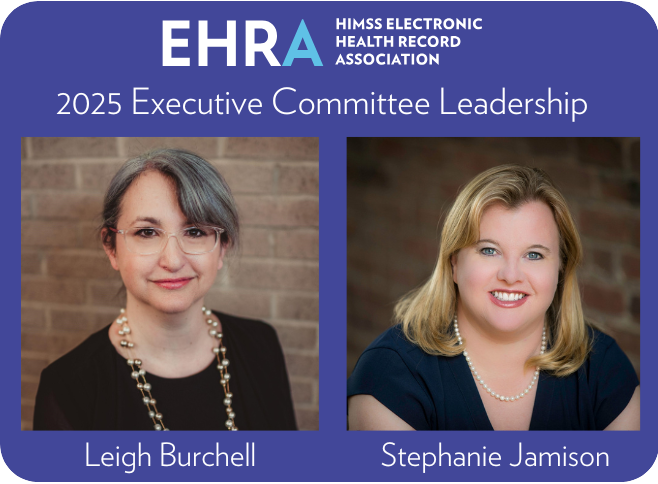
After serving as Chair this past year, Stephanie Jamison, Senior Director of Regulatory and Government Affairs with Greenway Health, has transitioned to Vice Chair of the trade association. The EHR Association’s 29 member companies serve most of the nation’s hospitals and ambulatory care organizations using EHRs and other health information and technology to deliver high-quality, efficient care to their patients.
(more…)Posted by EHR Association on January 7, 2025
https://ehrablog.org/2025/01/07/electronic-health-record-association-announces-leadership-team-and-priorities-for-fy25/
EHR Association Statement on HTI-2 Final Rule
Following is the statement from the EHR Association on the Dec. 11, 2024 publication by ASTP/ONC of the Health Data, Technology, and Interoperability: Trusted Exchange Framework and Common Agreement (HTI-2) Final Rule, which will publish in the Federal Register on Dec. 16, 2024. The scaled-based rule finalizes certain proposals related to the Trusted Exchange Framework and Common Agreement (TEFCA). It also amends the information blocking regulations by including definitions related to the TEFCA Manner Exception and implements provisions to support the reliability, privacy, security, and trust within TEFCA.
“This first rule finalizing parts of the HTI-2 proposals was released on December 11, 2024, and the focus on TEFCA allows ASTP to solidify pillars of that program that outgoing leadership wants to leave as a legacy. We expect the remaining components of the HTI-2 proposed rule to be split into multiple other final rules. In doing so, the EHR Association hopes that ASTP/ONC will prioritize the necessary additional technical corrections specific to health IT vendors, the most urgent of which relate to Insights Measures. As currently drafted, the Insights Measures are likely to produce data of questionable value – something we have been stressing to ASTP since publication of the HTI-1 proposed rule in 2023. As we inch closer to the January 1, 2026, start date, the uncertainty of finalized measurements creates challenges. We hope that future rules finalizing HTI-2 proposals will include helpful and necessary clarifications.”
Posted by EHR Association on December 12, 2024
https://ehrablog.org/2024/12/12/ehr-association-statement-on-hti-2-final-rule/
 EHRA Blog