How Not to Lose $1 Million: Preparing for OIG’s Information Blocking Enforcement

Guest post by Alya Sulaiman and James A. Cannatti III, Partners with McDermott, Will & Emery LLP

On Sept. 1, 2023, the HHS Office of Inspector General (OIG) began enforcing rules against information blocking in healthcare – authority it was granted under the 21st Century Cures Act – putting certified health IT developers, HINs, and HIEs at risk of civil monetary penalties (CMPs) of up to $1 million for each confirmed violation. (Ultimately, healthcare providers will also be subject to disincentives for information blocking not yet published by HHS.) The EHR Association’s membership is committed to preventing information blocking and supporting efforts to share electronic health information (EHI) to better patient care. Part of that is arming impacted health IT developers with as much information as possible to help them – and by extension, their customers – comply with current and future regulations to help protect themselves from potentially crippling penalties.

(more…)
Scoring is a Primary Concern with CORE’s proposed ASN eCQM

By Toni Wilken (Meditech), Vice Chair, Quality Measures Workgroup

Creation of the proposed Addressing Social Needs (ASN) electronic quality measure (eCQM) supports the important goal of addressing an unmet need in patient care by helping to improve screening and coordination with local and community-based resources. However, the EHR Association has identified several issues with the measure as proposed by its developer, Yale New Haven Health Services Corporation–Center for Outcomes Research and Evaluation (CORE), which we shared recently in our response to CORE’s call for comments.

ASN eCQM

Briefly, the Centers for Medicare & Medicaid Services (CMS) engaged CORE to develop a re-designed measure to evaluate how well hospitals were screening for and following up on the social needs of their patients. The result was the ASN eCQM, which is designed to measure screening of patients for social needs within four domains – food insecurity, housing insecurity, utility insecurity, and transportation insecurity – as well as if an intervention activity is performed. 

(more…)

The Ideal Clinician Note

By Brian R. Jacobs, MD, FHIMSS (eClinicalWorks)

This is the third in a blog series highlighting the discussions from the 2022 EHRA & HIMSS Physician Committee Summit: Meaningful and Streamlined Documentation.

When the EHRA and the HIMSS Physician Committee came together for a virtual Summit on meaningful and streamlined clinician documentation, three multidisciplinary breakout groups addressed key issues related to the topic. These included the ideal clinician note and barriers to creating such notes, which is the focus of this blog, as well as the exchange of the ideal note between providers and barriers to such exchange, and the specific EHR-related barriers to creating and/or consuming the ideal note. 

As noted in Documentation Burden: Addressing the Elephant in the Room, few disagree “that the focus of the note should be on the clinical encounter and ensuring the information entered clearly captures the problem, medical decision making, and ultimately help with communication between clinicians and our patients while meeting coding and regulatory compliance requirements. To continue this theme, this third blog will highlight the findings of the first Summit breakout group – which included physician, nursing, informatics, and EHR vendor representatives – discussing the topic of creating the ideal note, as well as the various barriers to creating that ideal note.

(more…)

2022 Clinical Workflow Flexibility Challenges in the EHR: Defining the Problem (Part Three)

In our two previous articles, we described an “as-is” exercise with the EHRA workgroup and the HIMSS Physician Committee members where one issue became the focus: the flexibility of workflows. This series of blog posts reviews the results of the exercise and describes a path forward. So far, this series has covered Learning the EHR, Personalizing the EHR and Understanding the Patient. In this article we discuss the fourth and final topic that was raised: Providing Care.

Providing Care
Providing medical care for the patient necessitates “last mile” flexibility that allows clinicians to jump in and out of the expected workflow. It has been demonstrated that a defined “workflow” that physicians agreed upon during development most commonly erodes after the first several steps. (1,2) The ability to step back into the workflow after a short detour needs to be readily available in an intuitive and simple manner. There should also be flexibility in how the EHR is used, both to conform to an individual’s working style as well as to respond to the demands of a clinical situation. Along these lines, but not limited to them, is the ability to have more than one patient record open with safeguards that ensure the correct data is always entered into the right patient’s chart.

(more…)

What Role Can Health IT Play When an Epidemic Meets a Pandemic?

By David Bucciferro (Foothold Technology), co-chair of the EHRA and the Opioid Task Force, and Renee Han (Epic), Opioid Task Force member

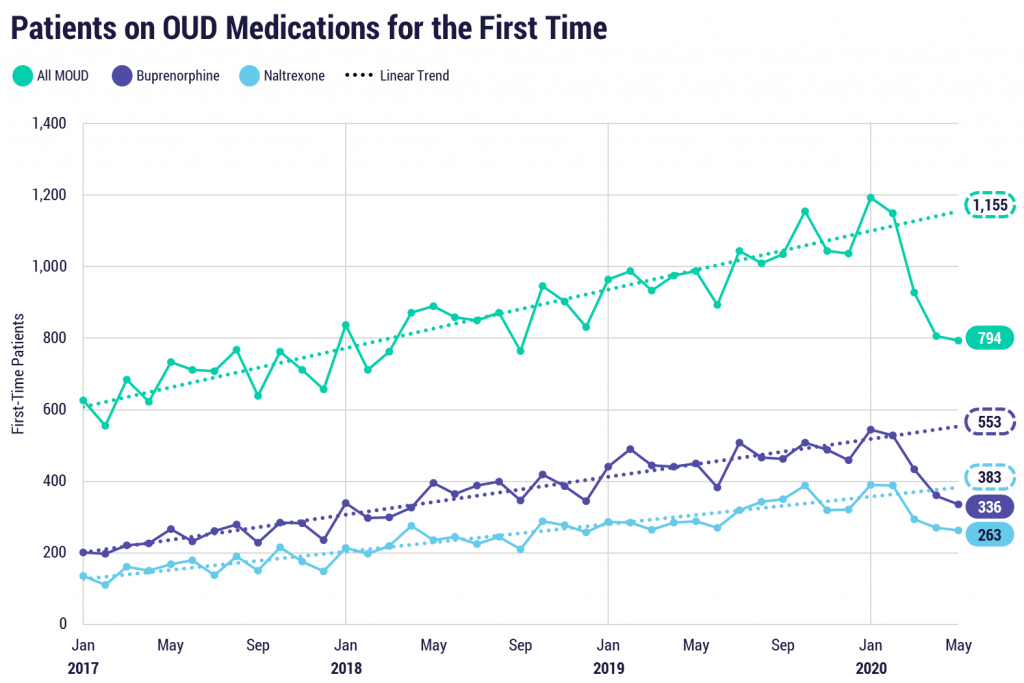
Over the past several years, community service and health professionals have fought hard to gain ground in the battle against the opioid epidemic. From 2017 until 2020, the number of patients receiving buprenorphine, methadone, or naltrexone – common medications for opioid use disorder (MOUD) – consistently increased as more patients at risk for OUD and overdose were identified and treated, according to a report from Epic Research

First-time MOUD, buprenorphine, and naltrexone patients over time. Solid colored capsules show the last observed value. Dashed outline capsules show the predicted value for May 2020. (Source: Epic Research.)

(more…)

“No Surprises Act” Regulations Raise Concerns

By Leigh Burchell (Allscripts), Chair, & Janet Campbell (Epic), Vice Chair,
EHRA Public Policy Leadership Workgroup

The growth in high deductible health plans requiring patients to shoulder more of their healthcare costs and the lack of transparency in healthcare pricing has exacerbated the issue of patients left with surprise medical bills that many cannot afford to pay. The urgent need to address these serious issues is why the EHRA supported the No Surprises Act when it was developed and welcomed the regulations published last year as a foundation upon which it can be implemented. 

However, we have several concerns about rulemaking to date as it relates to workability and the unnecessary burden it creates for industry stakeholders. To that end, we reached out proactively to regulatory agencies to provide feedback in four key areas that we believe – based on our member companies’ experiences and our ongoing advocacy for reasonable timelines and requirements – will be informative when it comes to additional regulatory actions expected later this year. 

(more…)
  • Categories

  • Follow EHRA on Twitter

  • Enter your email address to follow this blog and receive notifications of new posts by email.

    Join 198 other subscribers
  • Contact Us

    Kasey Nicholoff
    staff @ ehra.org

    Amanda Patanow
    Communications and Media
    ehracomms @ npccs.com